

The stock market is a place where people buy and sell small pieces of companies called stocks or shares. Imagine it like a big marketplace or a giant store where you can buy parts of a company, just like buying slices of a pizza. When you own a stock, you own a small part of that company. Companies sell stocks to raise money to grow their business, and people buy stocks to become part-owners and to possibly earn money as the company does well.
Simple Real-Life Example
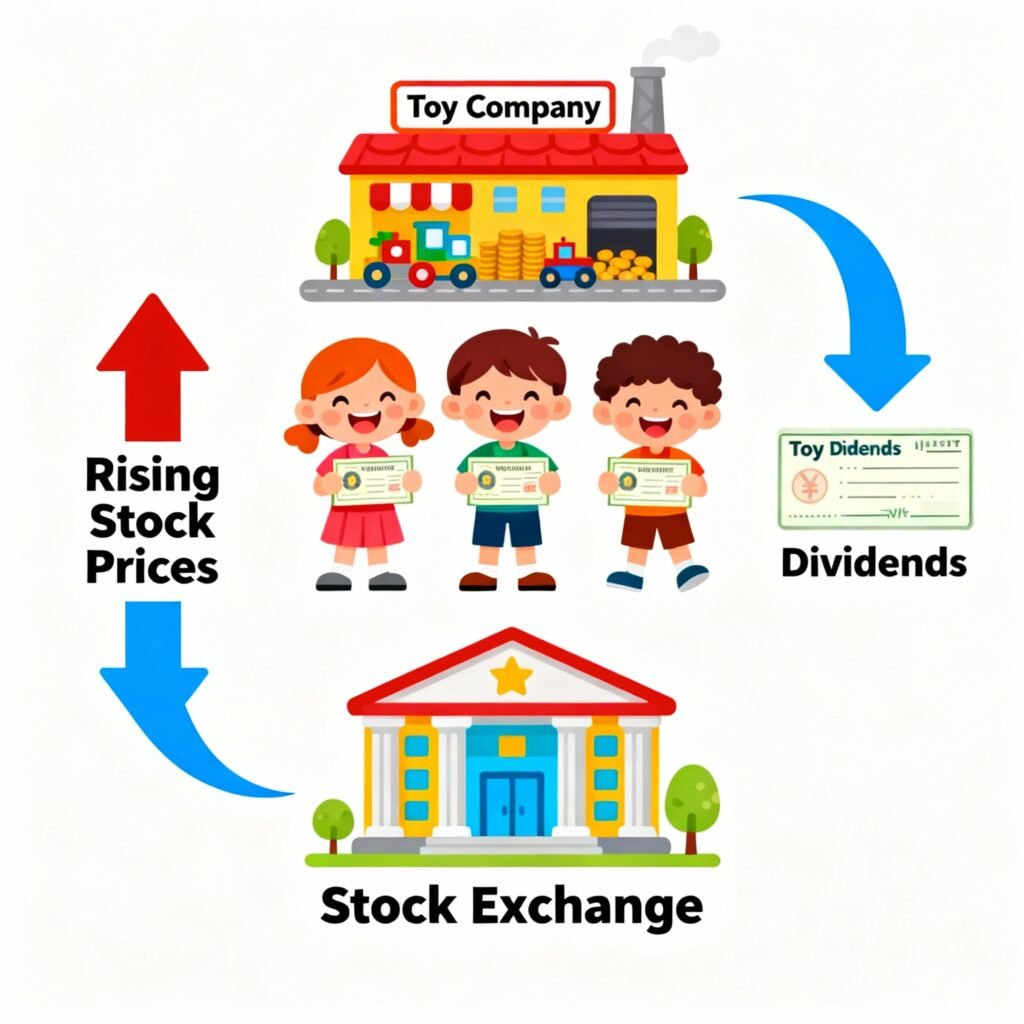
Imagine a toy company called “FunToys.” The company needs money to make more toys, so it breaks itself into tiny parts called shares or stocks. If you buy a share, it’s like owning a small piece of FunToys. If FunToys sells lots of toys and earns money, you get a little bonus called a dividend. If more people want to buy FunToys shares, their price goes up, and you can sell your share to earn money. But if FunToys doesn’t do well, the share price can go down too.
Important Stock Market Concepts
- Shares/Stocks: Parts of ownership in a company.
- Dividend: A share of the company’s profit given to shareholders.
- Bull Market: When stock prices are rising and people feel optimistic.
- Bear Market: When stock prices are falling and people feel pessimistic.
- Stock Exchange: The place where stocks are bought and sold (like NSE or BSE in India).
- Portfolio: Collection of different stocks or investments someone owns.
- Diversification: Not putting all your money in one company to reduce risk.
Important Ratios and Their Definitions
- Price-to-Earnings (P/E) Ratio: This ratio tells how much investors are willing to pay for a company’s earnings. It is calculated
P/E Ratio=Market Price per Share/Earnings per Share (EPS)
- Debt-to-Equity (D/E) Ratio: It measures how much money a company borrows compared to what investors have put in. Lower is usually safer.
D/E Ratio = Total Liabilities / Shareholders’ Equity
- Earnings Per Share (EPS): Profit a company makes per share.
EPS = Net Income / Number of Shares
- Dividend Yield: Shows how much dividend income a stock pays relative to its price.
Dividend Yield = (Annual Dividend per Share / Price per Share)×100
Key Stock Market Keywords with Definitions
- Bid Price: The highest price a buyer is willing to pay for a stock.
- Ask Price: The lowest price a seller is willing to accept.
- Market Order: An order to buy or sell a stock immediately at the current price.
- Limit Order: An order to buy or sell a stock at a specific price or better.
- Blue-chip Stocks: Shares of well-established and financially sound companies.
- Index: A tool that tracks the performance of a group of stocks (e.g., Sensex, Nifty).
- Volatility: How much and how quickly stock prices move up or down.

This explanation and glossary can be used to educate beginners and kids alike, making the basics of the stock market easy to understand and relate to real life.
Very good information
Very good and easy to understand nice .