
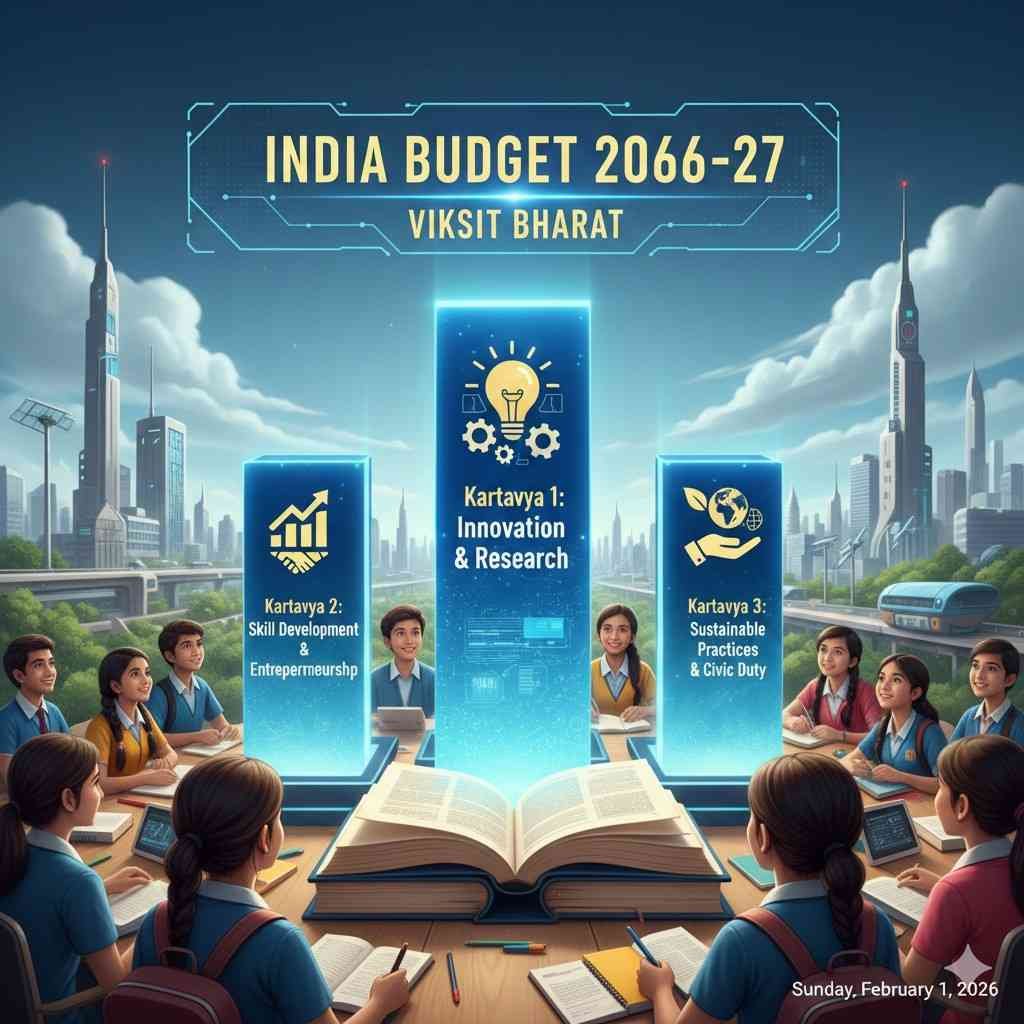
Introduction: The Vision of a Developed Nation
The Union Budget for 2026-2027 marks a definitive milestone in India’s journey toward Viksit Bharat (a Developed India). Following twelve years of steady economic growth averaging 7% and significant progress in poverty reduction, this budget serves as the structural blueprint for a nation ready to lead on the global stage.
The context of this year’s proposals is uniquely significant. For the first time, the budget was prepared in Kartavya Bhawan, a name that embodies the spirit of “duty” toward the nation. Furthermore, the proposals are deeply rooted in the aspirations of Yuva Shakti (Youth Power), having been inspired by innovative ideas shared during the Viksit Bharat Young Leaders Dialogue 2026.
The Government’s ‘Sankalp’ (Resolution)
Our Government’s core resolution is to focus on the poor, the underprivileged, and the disadvantaged. Our aim is to transform aspiration into achievement and potential into performance, ensuring that the dividends of growth reach every farmer, the scheduled castes, the scheduled tribes, the nomads, the youth, the poor, and the women. To achieve this vision, the budget is organized around three fundamental duties—the 3 Kartavyas—which provide the roadmap for national transformation
- The First Kartavya: Accelerating and Sustaining Economic Growth
The first pillar focuses on enhancing productivity and building resilience against global supply chain disruptions. The strategy centers on scaling domestic manufacturing in frontier sectors and establishing a world-class infrastructure network.
Frontier Sectors of Growth
To position India as a global industrial leader, the budget identifies strategic interventions to build entire ecosystems rather than just factories.
| Sector/Project Name | Key Objective | Impact for Future Industry |
| Biopharma SHAKTI | Establish India as a global Biopharma hub with a ₹10,000 crore outlay. | Establishes 3 new NIPERs, upgrades 7 existing ones, and creates 1,000 accredited clinical trial sites to modernize drug research. |
| ISM 2.0 (Semiconductors) | Design full-stack Indian IP and produce equipment/materials. | Establishes industry-led research and training centers to develop a specialized, high-tech workforce. |
| Rare Earth Corridors | Support mineral-rich states (Odisha, Kerala, Andhra Pradesh, Tamil Nadu). | Secures the domestic supply of critical minerals necessary for green energy and high-tech manufacturing. |
Creating “Champion MSMEs”
Micro, Small, and Medium Enterprises are the engine of India’s economy. The budget transitions them from mere survivors to global “Champions” through two innovative support systems:
- Professional Support (Corporate Mitras): The government will facilitate institutions like ICAI and ICSI to develop a new cadre of accredited para-professionals. For students of commerce and law, this creates a distinct new career track helping MSMEs in Tier-II and Tier-III towns manage affordable compliance.
- Liquidity Support (TReDS): By mandating TReDS as the settlement platform for government purchases and introducing receivables as asset-backed securities, the budget ensures MSMEs have the cash flow needed to scale.
A Powerful Push to Infrastructure
The budget allocates a record ₹12.2 lakh crore for public capital expenditure. This is not just about spending; it is about connecting the nation:
- Dedicated Freight Corridors: New routes connecting Dankuni in the East to Surat in the West.
- National Waterways (NW-5): Linking mineral-rich Talcher and Angul to the ports of Paradeep and Dhamra, supported by new Regional Centres of Excellence for manpower training.
- High-Speed Rail (HSR): Seven new corridors identified as “growth connectors”: Mumbai-Pune, Pune-Hyderabad, Hyderabad-Bengaluru, Hyderabad-Chennai, Chennai-Bengaluru, Delhi-Varanasi, and Varanasi-Siliguri.
By establishing the Infrastructure Risk Guarantee Fund, the government provides credit guarantees to lenders. This is a masterful application of fiscal prudence: by using guarantees rather than direct cash, the government leverages private investment, keeping the national deficit lower while still accelerating the construction of vital assets.
2. The Second Kartavya: Fulfilling Aspirations and Building Capacity
Capacity building ensures that every citizen becomes a strong partner in India’s prosperity. The High-Powered ‘Education to Employment and Enterprise’ (E3) Standing Committee has been established to make India a global leader in services, targeting a 10% global market share by 2047.
Skilled Pathways
The budget creates specialized vocational lanes for the youth of Viksit Bharat:
- Health: Beyond upgrading institutions for 100,000 Allied Health Professionals, the budget focuses on the “Care Economy,” training 1.5 lakh multiskilled caregivers for geriatric and wellness services.
- Orange Economy: The Animation, Visual Effects, Gaming, and Comics (AVGC) sector requires 2 million professionals by 2030. To meet this, AVGC Content Creator Labs will be established in 15,000 secondary schools and 500 colleges, creating a continuous educational pipeline.
- Design & Education: A new National Institute of Design (NID) will be established in Eastern India. Additionally, five University Townships will be created near industrial corridors to integrate academic life with industrial research.
Advanced Science and Research
To inspire the next generation of scientists, the budget funds four major astrophysics facilities: the National Large Solar Telescope, the National Large Optical-infrared Telescope, the Himalayan Chandra Telescope, and the COSMOS-2 Planetarium.
3. The Third Kartavya: Sabka Sath, Sabka Vikas (Inclusive Development)
Individual skill is a national waste if the regional infrastructure and social support systems are not there to sustain it. The third duty focuses on Purvodaya (the rise of the East) and ensuring no community is left behind.
Increasing Farmer Incomes
The focus shifts to high-value agriculture (Coconut, Cashew, Cocoa) to diversify income and reduce risk.
- Bharat-VISTAAR AI Tool: This multilingual tool serves as a digital consultant for the local farmer.
- Integrates AgriStack portals and the ICAR package of research-based agricultural practices.
- Provides customized advisory support tailored to specific soil and weather conditions.
- Reduces financial risk by enabling data-driven decision-making.
Inclusive Livelihoods and Health
The budget targets the specific needs of women, Divyangjan, and those in underserved regions.
| Initiative | Target Group | Key Project Example |
| SHE-Marts | Rural Women | Community-owned retail outlets for Self-Help Group products. |
| Divyang Sahara Yojana | Divyangjan | Assistive Technology Marts where citizens can try and buy AI-integrated devices. |
| Purvodaya | Eastern India | East Coast Industrial Corridor and Buddhist Circuits in the North-East. |
Mental Health & Trauma Care: Addressing a critical regional gap, the budget establishes NIMHANS-2, specifically because there are currently no national institutes for mental healthcare in North India. It also upgrades regional apex institutes in Ranchi and Tezpur.
Fiscal Foundations: The Engine Room of the Budget
For these grand plans to be sustainable, the nation’s finances must be managed with “Fiscal Prudence.” Think of fiscal consolidation like a family managing its debt responsibly today so it can comfortably afford a child’s university tuition tomorrow.
Fiscal Stability
The government aims to reach a debt-to-GDP ratio of 50±1% by 2030-31. By reducing the fiscal deficit (estimated at 4.3% for 2026-27), the government spends less on interest payments. This “freed-up” money is exactly what pays for the NIPERs, the high-speed rail, and the farmer support systems mentioned above.
Income Tax Act 2025: Ease of Living
The new Act, effective April 1, 2026, focuses on simplifying life for the average citizen:
- MACT Exemption: Interest awarded by Motor Accident Claims Tribunals is now tax-exempt, providing relief to accident victims.
- Education Support: The TCS (Tax Collected at Source) for those pursuing education abroad has been reduced from 5% to 2%.
- Foreign Asset Disclosure (FAST-DS): A one-time, 6-month scheme for students, young professionals, and tech employees to disclose overseas assets or income below ₹1 crore (Category A) or ₹5 crore (Category B) with immunity from prosecution, correcting honest past omissions.
CAPITALMENT Conclusion: The Student’s Role in Viksit Bharat
The Budget 2026-27 is a bridge from aspiration to achievement. It recognizes that for India to reach its 2047 goals, it must build the infrastructure of the future while empowering the people who will run it.
As a member of Yuva Shakti, you are at the heart of these three duties. Whether you are a future “Corporate Mitra” in a Tier-II town, a scientist at the National Large Solar Telescope, or an entrepreneur utilizing a SHE-Mart, this budget provides the scaffolding for your success. The roadmap is clear, the Sankalp is set, and the journey toward a developed India is well underway.
Jai Hind!