

Below is a simplified, “easy-words” guide to Art of Teaching (Pedagogy), covering all 12 topics in your syllabus for STET / Bihar exam. I’ll explain in bullet points, with simple examples, so even a small child (or someone new) can understand.
What is “Art of Teaching”?
- The “Art of Teaching” means how a teacher teaches well — the skill, care, creativity, techniques, planning, and relationship a teacher uses to help students learn.
- It is both an art (it requires creativity, sensitivity, adapting to students) and a science (it uses methods, plans, theories) of teaching.
- In Bihar STET exam, “Art of Teaching” is a important part of the syllabus and which is carring 30 marks.
- All topics listed in this is a part of “Art of Teaching” section in the Bihar STET syllabus.
1. Teaching & Learning
Meaning
- Teaching is when a teacher helps students to know, understand, and do things. It is guiding, explaining, showing, helping.
- Learning is when students gain knowledge, skills, or change in understanding. It’s what happens inside the students.
- Teaching and learning are like two sides of a coin: teacher teaches, students learn; but good teaching makes learning easier.
Process of Teaching (steps)
Here is a simple process (you can imagine it like cooking a dish):
- Planning – teacher decides what to teach, how, when.
- Presentation / Delivery – teacher gives lesson: explains, shows, demonstrates.
- Interaction / Practice – students do exercises, ask questions, participate.
- Feedback / Correction – teacher checks students’ work, gives feedback, corrects mistakes.
- Evaluation / Assessment – teacher checks how much students learned (tests, quizzes).
- Follow up / Reinforcement – teacher gives homework, revision, extra help as needed.
Characteristics (features) of Teaching & Learning
Good teaching and learning have these qualities:
| Characteristic | Meaning / Example |
|---|---|
| Goal oriented | Teaching is done for a purpose (what students should learn). |
| Interactive | Teacher and students must talk, ask, answer – not one‐way. |
| Continuous process | Teaching & learning don’t stop—they go on in class, revision, homework. |
| Adaptable | The teacher changes methods based on the students’ level. |
| Guided | The teacher guides, not just tells everything. |
| Child centered | Focus on what students need, their prior knowledge, their pace. |
| Evaluation integrated | Assessment is part of teaching (not only after everything). |
2. Teaching Objectives and Instructional Objectives
Meaning
- Teaching Objective: Big goal of teaching a subject – what teacher wants students to know or do by the end.
- Instructional Objective (Behavioral/Specific Objective): Detailed, small goals for a single class or topic — clear statements of what students will do (observable).
| Capitalment example :- |
| Teaching objective: “Students should understand the water cycle.” Instructional objective: “By end of the class, students will list 3 stages of water cycle and draw a diagram.” [ The water cycle consists of three primary stages: evaporation, condensation, and precipitation. Stages of the Water CycleEvaporation occurs when the sun heats water from oceans, rivers, and lakes, turning it into water vapor that rises into the atmosphere . This process is crucial for transferring water from the Earth’s surface to the air. Condensation happens when the water vapor cools at higher altitudes and changes back into tiny liquid droplets, forming clouds . This transformation from gas to liquid is essential for cloud formation. Precipitation occurs when the condensed water droplets in clouds combine and grow heavy enough to fall to the ground as rain, snow, or hail . This stage returns water to the Earth’s surface, completing the cycle. The process then repeats continuously, maintaining the balance of water on Earth ] |
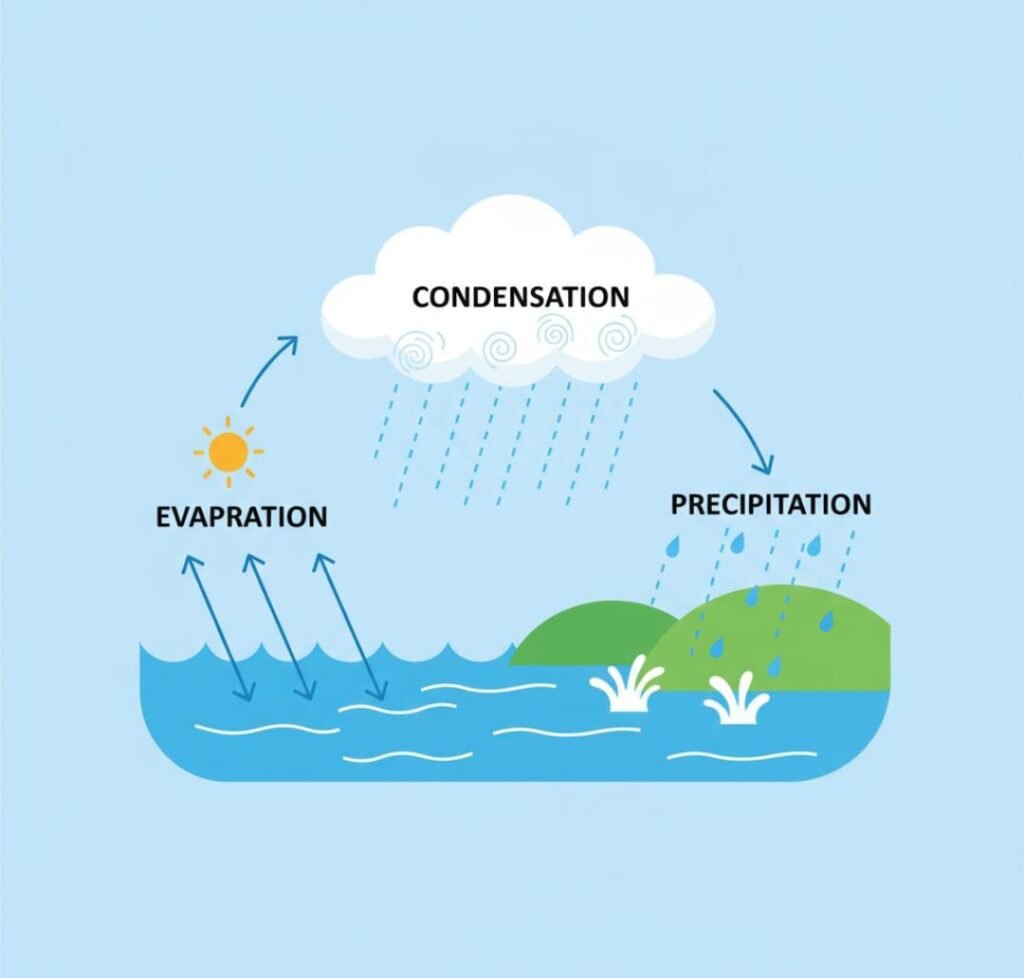
Types of Instructional Objectives
- Cognitive objectives (knowledge, understanding, thinking)
- Affective objectives (feelings, attitudes, values)
- Psychomotor objectives (skills, doing things with hands/body)
Bloom’s Taxonomy
Bloom’s Taxonomy is a way to classify cognitive objectives from simple to complex. The classic version has six levels:
- Remembering – recall facts, definitions
- Understanding – explain, rephrase, interpret
- Applying – use knowledge in new situations
- Analyzing – break into parts, compare, contrast
- Evaluating – make judgments, decide, argue
- Creating – put things together, design, invent
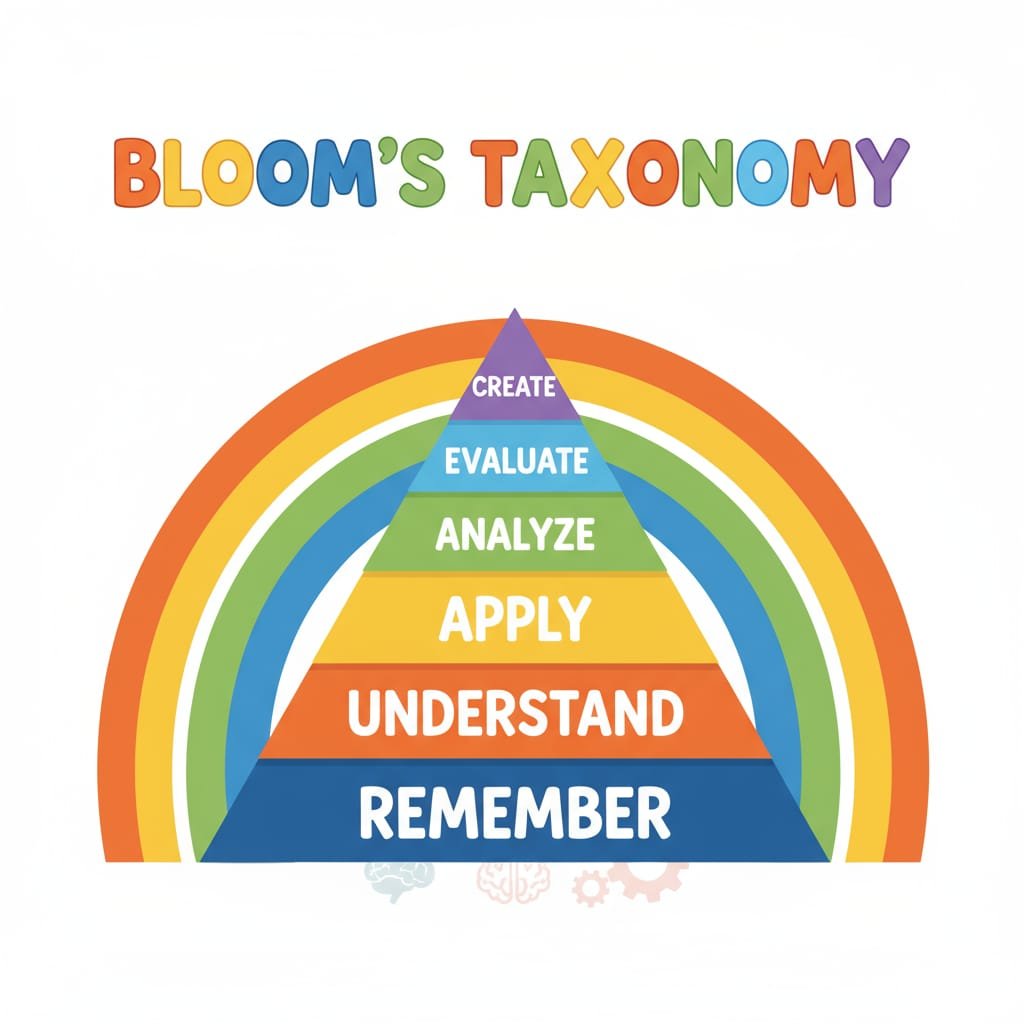
Teacher uses these levels when writing objectives and questions.
3. Teaching Methods
Types (Major) and their Characteristics
Here are some common methods, with simple explanation, plus their pros & cons:
| Method | What it is / How used | Merits (advantages) | Demerits (disadvantages) |
|---|---|---|---|
| Lecture / Lecture‐cum‐discussion | Teacher speaks, explains, gives information; may ask some discussion | Good for covering many points quickly; teacher controls content; efficient | Students may become passive, bored; low interaction; can’t check every student |
| Discussion method | Teacher and students discuss a topic together | Students are active, share views, develop thinking | Takes time; may go off track; teacher must regulate discussion |
| Demonstration method | Teacher shows or demonstrates a process or experiment, students observe then imitate | Very good for skills and processes; helps visual learners | Needs materials; some students may not see clearly; might not suit large class |
| Project method / Project based learning | Students do a project (e.g. build model, do research) | Develops creativity, self‐learning, collaboration | Time‐consuming; needs guidance; resources may be limited |
| Problem solving method | Teacher gives a problem (real or hypothetical); students analyze and find solutions | Promotes critical thinking, deeper understanding | Students may struggle; needs good facilitation; may be slow |
| Cooperative / Group learning | Students in small groups work together on tasks | Encourages teamwork, peer learning, active involvement | Some students may free‐ride; group dynamics problems; needs training |
| Lecture + Audio‐visual / Multimedia method | Teacher uses slides, videos, images along with lecture | More engaging; helps visualization; breaks monotony | Requires equipment, electricity; technical issues possible |
| Discovery method | Students discover knowledge themselves (guided by teacher) | Deep learning; students remember longer | Could be slow; not all students able to discover; teacher must scaffold well |
| Interactive / Activity method | Activities, games, hands‐on learning, experiments | Very motivating; links theory with practice | Needs preparation; may be chaotic; needs resources |
You can also categorize methods by who is central (teacher‐centered vs student‐centered) or by mode (individual, group, whole class).
Characteristics of Methods
- Every method should be learner‐friendly (suitable to students’ level).
- It should ensure active participation by students.
- It should help understanding, not just memorizing.
- It should allow feedback and correction.
- It should be flexible (teacher may shift method)
- It should be efficient (time, resources, class size considered).
4. Lesson Plan
Meaning
- A lesson plan is a detailed plan a teacher makes for a single class or session. It schedules what to teach, how to teach, what activities, time, resources, assessment, etc.
Types of Lesson Plan
- Short Lesson Plan – for a single period (class)
- Unit Plan / Long Lesson Plan – for a series of classes (a few days or weeks)
- Micro-lesson Plan – very short (5–10 minutes) for practice or demonstration
- Macro Plan – for a whole term or subject (rarely used by teacher; mostly school planners)
Format / Components of a Lesson Plan
A standard lesson plan may include:
- Title / Topic – name of lesson
- Class / Grade – which class
- Time / Duration – how long
- Objectives – instructional objectives for the lesson
- Prerequisite knowledge – what students already know
- Teaching aids / materials – charts, books, videos, models
- Introduction / Warm up – how to begin, engage interest
- Explanation / Presentation – how teacher will teach main content
- Activities / Practice – students’ exercises, group work, examples
- Assessment / Checking understanding – quizzes, questions, tests
- Feedback / Correction – how teacher will give feedback or correct mistakes
- Conclusion / Summary – wrap up key points
- Follow up / Homework / Assignment – what students will do later
Models of Lesson Plan
Some well-known “models” (ways of organizing lessons) are:
- Herbartian Model – phases: Preparation → Presentation → Association → Generalization → Application
- Madeline Hunter’s Model – phases: Anticipatory Set, Objective & Purpose, Input, Modeling, Checking for Understanding, Guided Practice, Independent Practice, Closure
- ASSURE Model (for use of media/technology): Analyze learners, State objectives, Select methods and media, Utilize media, Require learner participation, Evaluate & revise
- 5E Model – Engage, Explore, Explain, Elaborate, Evaluate
- Kemp’s Model – flexible, non‐linear planning, considering learner characteristics, content, strategies
These models help structure a lesson logically.
5. Microteaching & Instructional Analysis
Microteaching
- Microteaching is a technique for teacher training. The teacher (student teacher) teaches a very short lesson (e.g., 5 or 10 minutes) to a small group of students or peers.
- After that, they get feedback from observers, reflect, and improve.
- It helps in practicing specific teaching skills (explaining, questioning, introducing, concluding) in a controlled, safe environment.
- Pros: Low risk, easier to reflect and improve, focused on one skill.
- Cons: Artificial (not full class), may not capture real classroom pressure, limited time.
Instructional Analysis
- Instructional analysis means breaking down a subject or topic into small teachable steps or components.
- You analyze what knowledge or skills students must have before, the sequence of steps to teach, the prerequisite concepts.
- It ensures teaching is organized well, you don’t jump too fast or skip steps.
6. Effective Ecosystem of Classroom (or Effective Classroom Environment)
By “ecosystem of classroom,” we mean all the surroundings, activities, relationships, and supports that make a classroom conducive to learning. To make a good classroom environment, we need:
- Positive teacher–student relationship: respect, trust, caring
- Safe, disciplined environment: rules, order, respect
- Physical environment: good seating, light, ventilation, cleanliness
- Learning resources: textbooks, charts, models, tools, library, blackboard
- Variety of activities: lectures, group work, experiments, games
- Motivation & encouragement: rewards, praise, helping weak students
- Differentiation: catering to students with different levels
- Participation & engagement: students actively involved
- Feedback & formative assessment: regular checks, corrections
- Time management: starting on time, pacing, breaks
- Inclusiveness: every student feels included, no discrimination
When all these are good, the classroom becomes a place where students feel safe, curious, and ready to learn.
7. Textbook and Library
Textbook
- A textbook is a book that contains the content (facts, explanations, exercises) of a subject to be taught.
- It is the main guide for both teacher and students.
- Advantages of good textbook: accurate content, sequence, exercises, clarity, illustrations.
- But teacher should not depend wholly on the textbook — supplement, adapt, correct errors.
Library
- A library is a place (physical or digital) where many books, reference materials, periodicals are stored.
- It supports deeper learning — students and teachers can consult more books, explore beyond textbook.
- Use of library encourages reading habit, independent learning, reference skills.
- Teachers should guide students on how to use library: selecting books, note‐taking, referencing.
8. Qualities of Teacher
A good teacher should have many positive qualities. Here are main ones, in simple words:

- Subject knowledge – teacher knows the subject well
- Pedagogic knowledge – knows how to teach, what methods
- Communication skill – clear, simple language, good voice
- Patience – calm when students are slow
- Empathy / Understanding – knows students’ difficulties
- Creativity & adaptability – can change approach if needed
- Discipline & fairness – treats all students equally
- Enthusiasm & passion – love for teaching, energy
- Good behavior / role model – integrity, discipline
- Continuous learner – keeps learning new things
- Organizational skill – planning, managing class, materials
- Motivator – encourages students, builds confidence
9. Evaluation & Assessment for Learning
Meaning
- Evaluation is the process of determining how much learning has happened, how well students have achieved objectives.
- Assessment for learning (also called formative assessment) means checking students’ understanding during the learning process, so teacher can help and improve before final test.
Types of Assessment / Evaluation
| Type | When used | What it does |
|---|---|---|
| Formative assessment | during teaching (ongoing) | quizzes, class questions, assignments, observation – helps teacher adjust teaching |
| Summative assessment | at end of unit / term | final test, exam – to judge how much students learned overall |
| Diagnostic assessment | before starting topic | to find students’ prior knowledge, weaknesses |
| Continuous & Comprehensive Evaluation (CCE) | over time, many ways | tests, projects, oral work, attendance, behavior |
| Peer assessment / self assessment | by students themselves or among peers | students evaluate each other or themselves – builds responsibility |
Principles / Good Practices
- Assessment should be aligned with objectives (if objective is “apply,” test should require application).
- Use a mix of objective (multiple‐choice, short) and subjective (essay, projects).
- Give timely feedback — tell students where they went wrong and how to improve.
- Use assessment to improve learning, not only to grade.
- Be fair, transparent, avoid bias.
10. Curriculum
Meaning
- Curriculum is the set of courses, content, textbooks, experiences that a school offers. It is what is taught, and how it is organized (sequence, materials) over years.
- It includes subject matter, skills, values, activities.
Types / Approaches to Curriculum
- Formal curriculum – official documented syllabus, textbooks, exams
- Hidden curriculum – lessons learned indirectly (discipline, respect, teamwork)
- Co‐curriculum / Extracurricular – sports, arts, clubs, activities outside textbooks
- Null curriculum – what is left out (some topics may be excluded)
Principles / Considerations
- Curriculum should be child centered, relevant to students’ lives
- It should be flexible to adapt local needs
- Should have continuity and progression (from simple to complex)
- Balanced: knowledge, skills, values
- Linked to assessment, teacher training, resources
11. Factors Affecting Teaching and Learning
Many things influence how well teaching and learning occur. These factors can help or hinder.
External / Environmental Factors
- School infrastructure (rooms, desks, light, ventilation)
- Availability of teaching aids, lab, library
- Class size (number of students)
- Socio‐economic background of students (poverty, nutrition, family support)
- Culture, language, community values
- Administrative support, policy, curriculum demands
- Time (how much class time, schedule)
Internal / Personal Factors
- Students’ prior knowledge, intelligence, motivation
- Students’ learning style, interest
- Students’ health, attendance, psychological state
- Teacher’s preparation, subject knowledge, teaching skill
- Teacher’s behavior, attitude, personality
- Teacher’s use of methods, aids, feedback
Interaction – Teaching–Learning Process
- The interaction between teacher and student is central.
- If teacher uses appropriate method, encourages participation, gives feedback, adjusts to student needs, learning improves.
- Poor interaction (monologue, no feedback) weakens learning.
12. Teaching Aids and Hands-on Learning
Teaching Aids (Instructional Materials)
These are tools that help teaching to be easier, clearer, more interesting. Examples:

- Audio aids – tape recorder, radio
- Visual aids – charts, maps, posters, flash cards, pictures
- Audio‐visual aids – videos, slides, projector
- Physical models / real objects – models, specimens, real tools
- ICT / digital tools – computer, smartboard, educational software
- Textbook, worksheets, handouts
Importance / Merits
- Makes abstract ideas concrete
- Engages students (visual, audio)
- Helps in better retention & understanding
- Breaks monotony
- Appeals to different learning styles
Constraints or Demerits
- Cost, availability of materials
- Teacher training needed to use them
- Technical problems (power, equipment)
- Overuse may distract from core learning
Hands-on Learning
- Learning by doing — students handle materials, experiment, build, try out themselves.
- Very effective because students experience, make mistakes, correct, internalize.
- Example: in science class, students do experiment rather than only listening.
- It fits well with constructivist approaches (students build their knowledge through activity).
CAPITALMENT Q&A
Some Important Previous Questions (for STET / Bihar) with Short Answers
Here are examples of the kind of questions asked in past STET exams in “Art of Teaching” and short model answers:
- “Define the process of teaching.”
- Answer: The process of teaching includes planning, presentation, interaction/practice, feedback, evaluation, and reinforcement stages.
- “Name types of instructional objectives and explain one.”
- Answer: Cognitive, affective, psychomotor. (Explain cognitive: concerned with knowledge, thinking, e.g., remembering, understanding, applying, etc.)
- “Write merits and demerits of demonstration method.”
- Answer: Merits: Students see process, make learning concrete, good for skills. Demerits: Requires resources, not all may see, time consuming.
- “What is microteaching and its importance?”
- Answer: Microteaching is teaching a short lesson to a small group with feedback. It is important as a safe practice ground to improve teaching skills.
- “List qualities of a good teacher.”
- Answer: Subject knowledge, patience, communication skill, empathy, creativity, fairness, enthusiasm, continuous learning, etc.
- “What is formative assessment? Why is it used?”
- Answer: Formative assessment is ongoing assessment during teaching to check students’ understanding. It is used so that teacher can adjust teaching and help students before final evaluation.
- “What is a lesson plan? Name any one model.”
- Answer: A lesson plan is a structured plan for a single teaching session. One model is the 5E model (Engage, Explore, Explain, Elaborate, Evaluate).
Make sure in your exam you write clean definitions, give examples (from your subject), and use bullet points.
Capitalment Tips for Remembering & Writing in Exam
- Always start with a definition in your own words.
- Use examples (from Bihar’s schools, from your subject).
- Use headings / bullet points – examiners like that.
- Where asked merits/demerits, use a table.
- Link pedagogy ideas to classroom in Bihar (e.g. lack of resources, big class, rural students).
- Practice drawing lesson plan format diagram in notebook.
- Learn Bloom’s levels in order and remember one example for each.
- For teaching methods, remember for each: how-to use, advantage, disadvantage.
- For textbooks and libraries, mention reality in Bihar — many rural schools have weak libraries, outdated textbooks.
- For evaluation, mention both formative and summative, and stress “feedback helps learning.”
- For curriculum, mention how state syllabus and local needs combine; mention hidden curriculum.
- Always try to link theory to practical (a teacher showing, students doing, class in Bihar).
Capitalments Quick Revision of whole article 🧠 ART OF TEACHING – QUICK REVISION SHEET (for Bihar STET)
Informative