
💳 What Is a Credit Card?
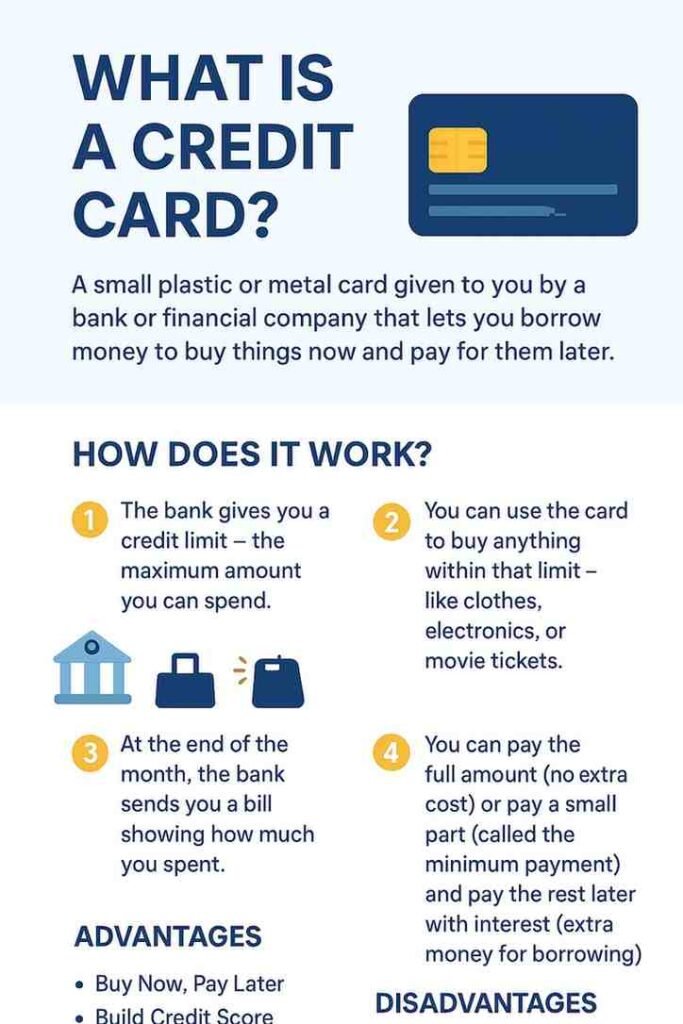
A credit card is a small plastic or metal card given to you by a bank or financial company that lets you borrow money to buy things now and pay for them later.
You can use it to shop in stores, buy things online, or even pay bills — without using your own cash right away.
🏦 How Does It Work?
Here’s how a credit card works step by step:
- The bank gives you a credit limit — the maximum amount you can spend (for example, ₹50,000).
- You can use the card to buy anything within that limit — like clothes, electronics, or movie tickets.
- At the end of the month, the bank sends you a bill showing how much you spent.
- You can:
- Pay the full amount (no extra cost)✅ , or
- Pay a small part (called the minimum payment) and pay the rest later with interest (extra money for borrowing).🚫
| CAPITALMENTS NOTES :~ |
| 1. Alway pay full amount✅ if you pay minimum payment🚫 most of your payments goes towards interest rather than reducing the principal balance. 2. Keep paying on time. ( Late payments impact your credit score negetively.) 3. Avoid more credit checks (This may indicat a high demand for credit and could be view negatively.) 4. Never use above 30% of your credit limit. 5. Never withdraw cash from your credit card. |
💰 Example:
Let’s say your card limit is ₹1,00,000.
You buy a new phone for ₹60,000 using your credit card.
At the end of the month:
- If you pay ₹60,000 before the due date → ✅ no extra charge.
- If you pay only ₹30,000 → ⚠️ you’ll pay interest on the remaining ₹30,000 next month.
So, a credit card is like a short-term loan that helps you buy first and pay later — but you must repay it on time to avoid extra costs.
🪙 Difference Between Credit Card and Debit Card
| Feature | Credit Card | Debit Card |
|---|---|---|
| Source of Money | Borrowed from the bank | Taken from your own bank account |
| Payment Time | Pay later | Pay immediately |
| Interest | Charged if not paid on time | No interest |
| Rewards | Earn points or cashback | Sometimes limited rewards |
| Risk | Can lead to debt if overspent | Safer, as you use your own money |
🌟 Advantages of a Credit Card
- Buy Now, Pay Later: You don’t need to pay immediately.
- Build Credit Score: If you pay on time, your credit score improves — which helps in getting loans later.
- Rewards and Cashback: Many cards give discounts, cashback, or travel points.
- Safety: You don’t have to carry cash; if lost, you can block the card.
- Emergency Use: Helpful in emergencies when you need money quickly.
⚠️ Disadvantages of a Credit Card
- High Interest: If you don’t pay the bill on time, the bank charges heavy interest.
- Debt Trap: Spending too much can lead to unpaid bills and debt.
- Annual Fees: Some cards charge yearly maintenance fees.
- Overspending Risk: It’s easy to spend more than you can afford.
📊 Credit Card Terms You Should Know
| Term | Meaning |
|---|---|
| Credit Limit | The maximum money you can spend on your card. |
| Billing Cycle | The time period (usually 30 days) for which your spending is calculated. |
| Due Date | The date by which you must pay your bill. |
| Minimum Payment | The smallest amount you must pay to avoid penalties. |
| Interest Rate (APR) | The extra percentage the bank charges if you don’t pay in full. |
| Reward Points | Points earned for spending; can be used for discounts or gifts. |
🧠 Smart Tips for Using Credit Cards Wisely
- 💵 Spend only what you can pay back next month.
- ⏰ Pay your bills before the due date to avoid interest.
- 📱 Track your spending using the bank’s app.
- 🛍️ Use rewards smartly — for travel, shopping, or cashback.
- 🚫 Avoid withdrawing cash using a credit card (it attracts high fees).
🧩 Capitalment Conclusion:
A credit card is like borrowing money from the bank for a short time to buy things.
It’s a powerful tool when used responsibly — but dangerous if misused.
If you pay bills on time and spend wisely, a credit card can help you build financial strength and earn rewards.