
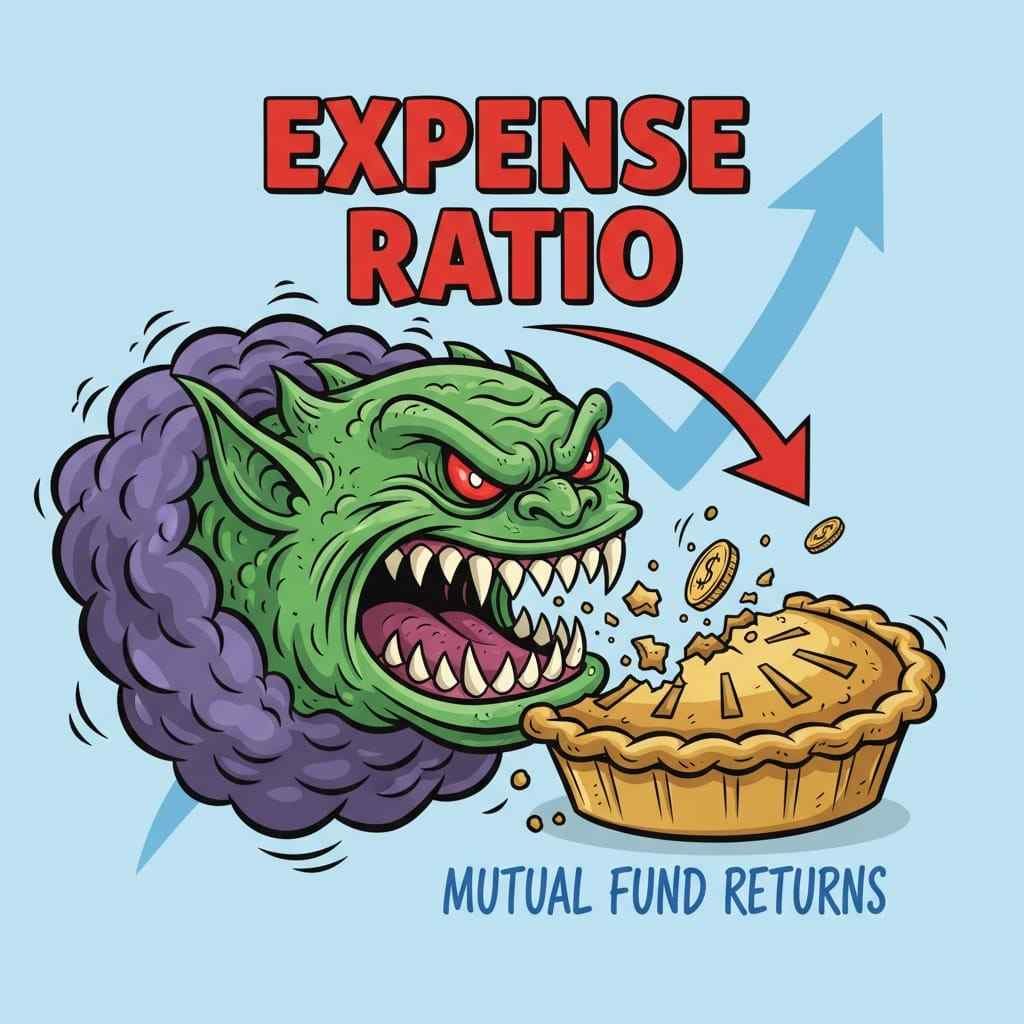
Imagine buying a pizza for ₹500, but the delivery person charges you ₹10 every year just for keeping it in your fridge. Sounds odd, right? But this is exactly what happens with mutual funds through something called the expense ratio. Let me break this down in the simplest way possible.
What is Expense Ratio?
The expense ratio is the annual fee that mutual fund companies charge you for managing your money. Think of it as a maintenance charge for your investments.
Simple Definition: If you invest ₹1,00,000 in a mutual fund with a 1% expense ratio, you’ll pay ₹1,000 per year as fees to the fund house.
The critical part? This fee is automatically deducted from your investment returns—you never see it directly, which is why most investors don’t realize how much it costs them over time.
Real-Life Example to Understand the Impact
Let me show you two friends investing the same amount:
Scenario: Vishal vs. Arti
Both invest: ₹10,00,000 (10 lakhs) Investment period: 20 years Expected annual return: 12% (before expenses)
Vishal’s Fund:
- Expense Ratio: 2%
- Actual return: 12% – 2% = 10%
- Final amount after 20 years: ₹67,27,500
Arti’s Fund:
- Expense Ratio: 0.5%
- Actual return: 12% – 0.5% = 11.5%
- Final amount after 20 years: ₹91,45,866
The shocking difference: ₹24,18,366 (almost 24 lakhs!)
Just by choosing a fund with a lower expense ratio, Arti earned an extra 24 lakhs on the same 10 lakh investment. This is the power of understanding expense ratios.
What Does the Expense Ratio Cover?
Your annual fee pays for several things:
Fund Management Fees: Salaries of fund managers who decide which stocks or bonds to buy and sell.
Administrative Costs: Office expenses, employee salaries, technology systems, customer service operations.
Marketing and Distribution: Advertising costs, commissions to distributors and financial advisors who sell the fund.
Legal and Audit Expenses: Regulatory compliance costs, auditor fees, legal documentation.
Custodian Charges: Fees for safely storing securities and maintaining records.
Other Operational Costs: Research expenses, software subscriptions, transaction costs for buying and selling securities.
How is Expense Ratio Calculated?
The formula is straightforward:
Expense Ratio = (Total Fund Expenses / Total Assets Under Management) × 100
Example Calculation:
A mutual fund has:
- Total expenses for the year: ₹2 crores
- Total assets (money invested by all investors): ₹200 crores
Expense Ratio = (2 / 200) × 100 = 1%
This means every investor in this fund pays 1% of their investment value annually as fees.
SEBI’s Expense Ratio Limits in India
The Securities and Exchange Board of India (SEBI) has set maximum limits to protect investors from excessive charges:
For Equity Funds:
- First ₹500 crores: Maximum 2.25%
- Next ₹250 crores: Maximum 2.00%
- Next ₹1,250 crores: Maximum 1.75%
- Next ₹3,000 crores: Maximum 1.60%
- Above ₹5,000 crores: Maximum 1.50%
For Debt Funds:
- First ₹500 crores: Maximum 2.00%
- Next ₹250 crores: Maximum 1.75%
- Next ₹1,250 crores: Maximum 1.50%
- Above ₹2,000 crores: Maximum 1.05%
Key Insight: Larger funds typically have lower expense ratios because costs get distributed among more investors—like splitting a taxi fare among more people.
Direct vs Regular Plans: The Game Changer
This is where most investors lose money without knowing it.
Regular Plan:
- Bought through a distributor or advisor
- Includes commission for the intermediary
- Higher expense ratio (typically 0.5% to 1% more)
Direct Plan:
- Bought directly from the fund house or their website
- No distributor commission
- Lower expense ratio
Real Comparison:
HDFC Equity Fund Example:
- Regular Plan Expense Ratio: 2.10%
- Direct Plan Expense Ratio: 1.35%
- Difference: 0.75%
₹10 Lakh invested for 20 years at 12% return:
- Regular Plan (10.9% after expenses): ₹79,43,000
- Direct Plan (11.65% after expenses): ₹97,86,000
Extra earning with Direct Plan: ₹18,43,000
You earn nearly 18 lakhs more simply by choosing the direct option. The shocking part? You get the exact same fund, same stocks, same manager—just without the middleman commission.
Types of Expense Ratios Across Fund Categories
Different fund types have different expense structures:
Index Funds and ETFs: 0.05% to 0.50%
These are the cheapest because they simply copy an index like Nifty 50. No expensive research or active decision-making needed. Perfect for cost-conscious investors.
Actively Managed Equity Funds: 0.50% to 2.25%
Higher costs because fund managers actively research and select stocks. They’re trying to beat the market, which requires extensive analysis and frequent trading.
Debt Funds: 0.20% to 2.00%
Generally cheaper than equity funds because managing bonds is less complex than managing stocks. Less research and lower trading activity mean lower costs.
International Funds: 0.50% to 2.50%
Often higher because of additional complexities—currency conversion, foreign regulations, and research on international markets add to operational costs.
Fund of Funds: 1.00% to 3.00%
The most expensive category because you’re paying two layers of fees—one for the main fund and another for the underlying funds it invests in. Generally best avoided unless absolutely necessary.
How to Check Expense Ratio
Finding this information is easier than you think:
Method 1: Fund Fact Sheet
Every mutual fund publishes a monthly fact sheet on their website. The expense ratio is clearly mentioned, usually on the first page under “Fund Details” or “Key Information.”
Method 2: AMFI Website (Association of Mutual Fund in India)
Visit amfiindia.com, search for your fund, and download the fact sheet. All registered mutual funds must disclose this information.
Method 3: Investment Apps
Apps like Groww, Zerodha Coin, Paytm Money, or ET Money display the expense ratio prominently on each fund’s page before you invest.
Method 4: Fund House Website
Go directly to the fund company’s website, navigate to the fund you’re interested in, and look for “Scheme Information” or “Fund Details.”
Method 4: Scheme Information Document (SID)
This detailed legal document lists all charges and fees. It’s comprehensive but slightly technical.
Capitalment Smart Strategies to Minimize Expense Impact
Strategy 1: Always Choose Direct Plans
This single decision can save you lakhs over your investment lifetime. With today’s technology, buying direct is as easy as buying regular plans.
Strategy 2: Prefer Index Funds for Core Portfolio
For long-term wealth building, low-cost index funds often outperform expensive actively managed funds simply because of lower costs.
Strategy 3: Avoid Fund of Funds
Unless there’s a compelling reason (like specific international exposure), these double-fee structures rarely justify their cost.
Strategy 4: Compare Within Categories
When choosing between similar funds, expense ratio should be a key deciding factor alongside past performance and fund manager track record.
Strategy 5: Invest in Larger Funds
Bigger funds benefit from economies of scale—their expense ratios are typically lower because costs are spread across more investors.
Strategy 6: Review Annually
Expense ratios can change. Check your existing funds once a year to ensure they’re still competitive.
Common Myths About Expense Ratio
Myth 1: “Higher expense ratio means better management”
Reality: There’s no proven correlation between high fees and better returns. Many low-cost funds consistently outperform expensive ones.
Myth 2: “Expense ratio doesn’t matter for short-term investments”
Reality: Even for one year, a 2% expense ratio on ₹5 lakhs means you lose ₹10,000. That’s real money.
Myth 3: “I don’t pay anything because I don’t see any deduction”
Reality: The expense is deducted from the fund’s NAV (Net Asset Value) daily. You never see it, but you’re definitely paying it.
Myth 4: “Only returns matter, not expenses”
Reality: Past returns are already after expense deduction. A fund showing 10% return with 2% expense ratio actually earned 12% but you only got 10%.
Myth 5: “Zero expense ratio funds exist”
Reality: While some funds market themselves as “zero expense” during promotions, there’s always some cost. Read the fine print carefully.
The Compounding Effect of Expense Ratio
This is where expense ratios truly hurt—or help—your wealth.
Long-term Impact Illustration:
Monthly SIP: ₹10,000 Duration: 30 years Expected return: 12% per year
| Expense Ratio | Net Return | Final Corpus | Money Lost to Fees |
|---|---|---|---|
| 0.5% | 11.5% | ₹2,89,99,000 | ₹26,99,000 |
| 1.0% | 11.0% | ₹2,61,36,000 | ₹55,62,000 |
| 1.5% | 10.5% | ₹2,35,73,000 | ₹81,25,000 |
| 2.0% | 10.0% | ₹2,13,08,000 | ₹1,03,90,000 |
Total invested: ₹36,00,000 (10k × 12 months × 30 years)
Notice how a seemingly small 1.5% difference in expense ratio (between 0.5% and 2%) results in a massive ₹76,91,000 difference in your final wealth. That’s more than twice your total investment!
When Higher Expense Ratios Might Be Acceptable
While I strongly advocate for low-cost investing, there are rare situations where paying more might make sense:
Specialized Sector Funds
Funds focusing on niche sectors (like biotechnology or emerging technologies) require specialized research that justifies slightly higher costs.
Emerging Market Funds
Investing in frontier markets involves additional research complexity, regulatory navigation, and risk management that can warrant higher expenses.
Small-cap Funds
Actively managing small-cap stocks requires extensive research, frequent monitoring, and dealing with liquidity challenges, which can justify moderately higher costs.
Tax-saving ELSS Funds
If a slightly expensive ELSS fund consistently outperforms cheaper alternatives by a significant margin, the extra returns might offset the higher expense ratio.
Important caveat: Even in these cases, the expense ratio should still be reasonable within the category—not the absolute maximum allowed.
Red Flags to Watch Out For
Warning Sign 1: Expense Ratio Above Category Average
If a fund charges significantly more than similar funds without demonstrably better performance, that’s a red flag.
Warning Sign 2: Frequent Increases
Check if the expense ratio has been steadily climbing. This might indicate inefficient management or decreasing assets.
Warning Sign 3: Hidden Charges
Some funds have exit loads, transaction fees, or other charges on top of the expense ratio. Read the fine print.
Warning Sign 4: Underperformance Despite Low Expenses
If even a low-cost fund consistently underperforms its benchmark, low expenses won’t save you. Performance matters too.
Capitalment Personal Take on Expense Ratios
After years of observing investor behavior and market patterns, Capitalment firmly believe that expense ratio is one of the most underestimated factors in investment success. Here’s why it matters so much to Capitalment:
Control What You Can Control: Market returns are unpredictable and beyond your control. But expense ratio? That’s completely within your control from day one.
The Certainty Factor: While fund performance fluctuates, the expense ratio is a guaranteed cost you’ll pay every single year. It’s the one thing you know for certain about your future returns.
Compounding Works Both Ways: Just as your money compounds to grow wealth, expenses also compound to erode wealth. Over decades, this silent drain becomes a roaring river.
The Direct Plan Revolution: The introduction of direct plans was one of the best regulatory changes for Indian investors. Yet, surprisingly, most investors still use regular plans, essentially paying thousands of rupees to someone for clicking a button they could click themselves.
Index Funds Are Underrated: For most investors—especially beginners—a portfolio of low-cost index funds will outperform a portfolio of expensive actively managed funds over 15-20 years. The math is simple and proven across global markets.
Capitalment Practical Action Plan for You
Here’s what you should do right now:
Step 1: Audit Your Current Portfolio
List all your mutual fund investments and note down their expense ratios. You can find this on your investment app or the fund’s website.
Step 2: Identify High-Cost Funds
Highlight any fund with an expense ratio above 1.5% for equity or 1% for debt. These need scrutiny.
Step 3: Switch to Direct Plans
If you’re in regular plans, calculate how much you could save by switching to direct plans. For most people, this alone saves ₹10,000-50,000 annually.
Step 4: Consider Index Funds
Allocate at least 50-70% of your equity portfolio to low-cost index funds. They form a solid, worry-free foundation.
Step 5: Review Annually
Set a reminder to check expense ratios once a year. Fund houses can change these, and you should stay informed.
Step 6: Educate Yourself Continuously
The more you understand about costs, returns, and compounding, the better financial decisions you’ll make throughout life.
The Capitalment Bottom Line
The expense ratio is not just a technical detail buried in fund documents—it’s a powerful determinant of your long-term wealth. A difference of just 1% might seem trivial when you’re starting, but over 20-30 years, it can mean the difference between a comfortable retirement and financial stress.
Think of it this way: Would you leave a tap running that drips ₹50 every day? Probably not. Yet, many investors ignore expense ratios that leak far more than that from their wealth over time.
The good news? Unlike market volatility or economic uncertainty, expense ratio is completely within your control. Choose wisely, choose directly, and choose low-cost options whenever possible.
Your future self—sitting on a significantly larger retirement corpus—will thank you for paying attention to this seemingly small detail today.
Remember: In investing, every rupee saved in fees is a rupee that compounds for your future. And that compounding is the true magic of wealth creation.
Capitalment Final Thought:
The best investment strategy isn’t about finding the perfect stock or timing the market—it’s about consistently investing in low-cost, diversified funds over long periods. Master this simple principle, and you’re already ahead of 90% of investors.
Never seen such beautiful types of explanation on expense ratio on mutual fund. This article fully clear my concepts. Thanks Team of Capitalment.
Si te encuentras buscando alguna una experiencia singular, el refugio en esferas es una opcion que resulta digno de descubrir. burbujas granada Existen variadas alternativas en el pais, incluyendo alojamiento burbuja en el sur de Espana hasta hospedajes en burbujas cercanos a Madrid, pasando por burbujas en Cataluna y alrededores o en Murcia y sus alrededores, con puntos destacados como la famosa burbuja estrella polar Murcia o la burbuja bardenas en Navarra. Para personas que quieren algo memorable, la vivencia burbuja Madrid o el estancia en burbuja Cataluna presentan estancias unicas en un marco natural.
De igual forma, puedes hallar burbujas hotel en lugares como Alicante, Barcelona, la costa de Malaga o Granada, ideales para escapadas romanticas o de naturaleza. Si quieres conocer precios y mas detalles, en este sitio encontraras todos los detalles sobre burbujas en distintos puntos de Espana, destacando las iconicas bardenas reales burbujas y burbujas en Madrid . Es una forma ideal de abstraerse y gozar de la belleza natural sin abandonar la comodidad ni el bienestar.